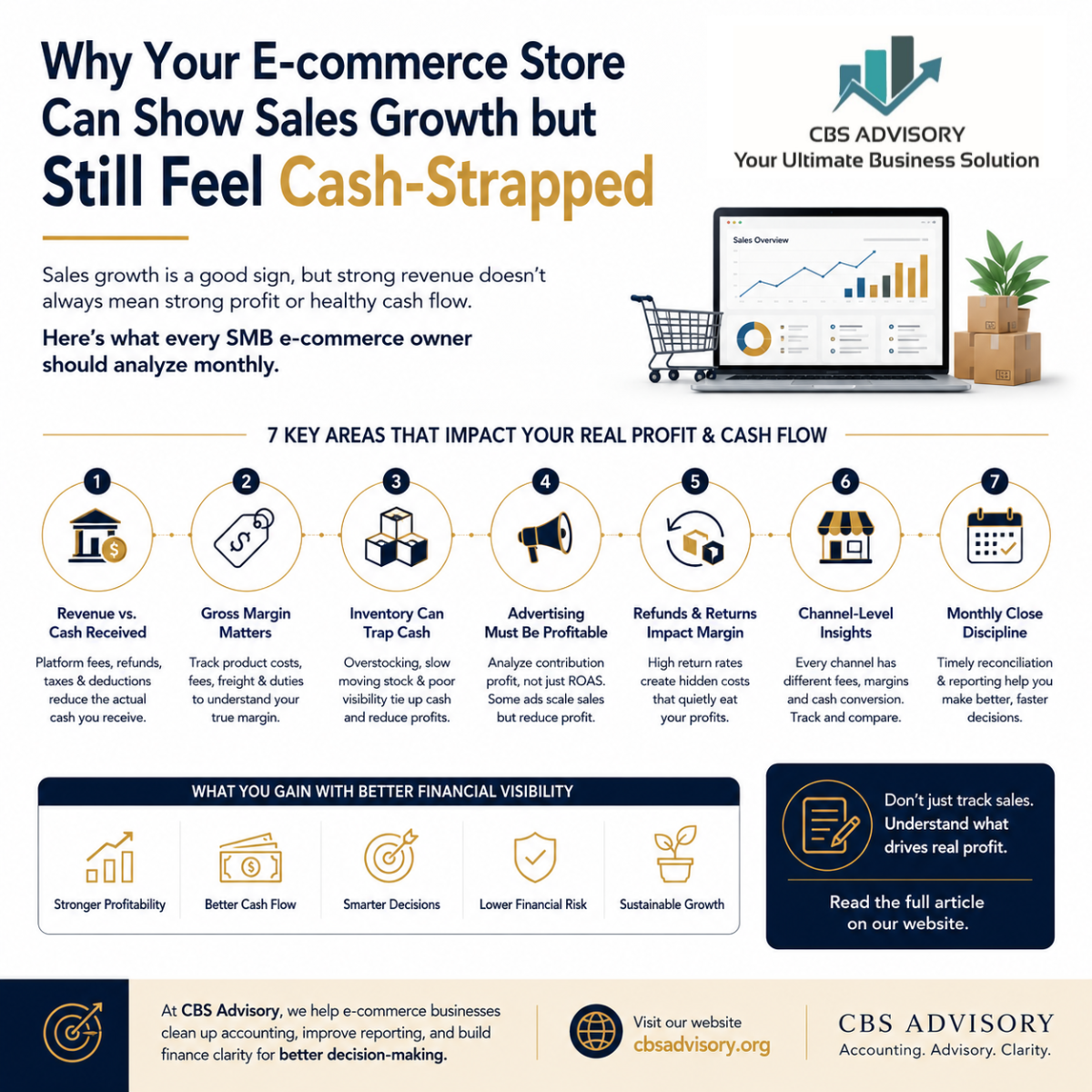
Why Your E-commerce Store Can Show Sales Growth but Still Feel Cash-Strapped
For many small and mid-sized e-commerce businesses, revenue growth feels like the main scoreboard. More orders, higher sales, stronger marketplace activity, and better website traffic all look positive from the outside.
But here is the issue: sales growth does not automatically mean profit growth. And profit growth does not automatically mean cash flow improvement.
This is where many e-commerce businesses struggle. They look at sales reports from Shopify, Amazon, WooCommerce, or other platforms and assume the business is moving in the right direction. But the accounting records, bank balance, inventory movement, advertising spend, and payment gateway deductions may tell a very different story.
At CBS Advisory, we believe e-commerce business owners should not only know “how much they sold.” They should know what those sales actually produced after cost, fees, inventory, refunds, and operating expenses.
1. Revenue Is Not the Same as Cash Received
An e-commerce sales report usually shows gross sales. But the amount deposited into your bank account is usually lower.
Why?
Because several deductions may happen before the cash reaches your account, such as:
- Payment gateway fees
- Marketplace commissions
- Refunds and chargebacks
- Shipping adjustments
- Sales tax or VAT collected
- Platform service charges
- Advertising deductions in some marketplace setups
For example, a store may show $50,000 in monthly sales, but the actual bank deposit may be much lower after all platform-level deductions. Without proper reconciliation, the business owner may overestimate revenue, underestimate expenses, or misread the real margin.
A clean accounting process should reconcile platform sales, payment processor settlements, bank deposits, refunds, and fees. Otherwise, the financial statements will not reflect the real economics of the business.2. Gross Margin Matters More Than Gross Sales
A common e-commerce mistake is focusing heavily on top-line revenue while ignoring gross margin.
Gross margin shows how much money remains after deducting the direct cost of products sold. For product-based businesses, this is one of the most important performance indicators.
A business selling $100,000 per month with a 20% gross margin may be less healthy than a business selling $60,000 per month with a 45% gross margin.
Key items that affect gross margin include:
- Product purchase cost
- Freight and import cost
- Packaging cost
- Customs duties
- Marketplace fulfillment fees
- Product damage or shrinkage
- Supplier price changes
- Discounting strategy
If landed cost is not properly tracked, the business may believe it is profitable when the actual margin is weak.
For e-commerce SMBs, the question should not only be: How much did we sell?
The better question is: “How much did we keep after product-level cost?”
3. Inventory Can Create a Cash Flow Trap
Inventory is one of the biggest cash flow pressure points in e-commerce.
When a business buys inventory, cash leaves the bank immediately. But that inventory may not become an expense in the profit and loss statement until the product is sold. This means the profit report may look acceptable while the bank balance feels tight.
This is especially important for businesses that import products, hold seasonal stock, or sell through multiple channels.
Inventory problems usually appear in three forms:
- Overstocking slow-moving products
- Stockouts on profitable products
- Poor visibility over inventory value and turnover
A healthy e-commerce business should monitor inventory turnover, slow-moving SKUs, reorder levels, and product-level profitability.
Without inventory analysis, business owners may keep reinvesting cash into products that are not generating strong returns.
4. Advertising Spend Must Be Connected to Profit, Not Just Sales
Many e-commerce businesses track ad spending against revenue, but not against contribution margin.
Return on ad spending, commonly known as ROAS, is useful — but incomplete.
A product may generate strong sales from advertising but still produce weak profit after deducting:
- Product cost
- Platform fees
- Fulfillment cost
- Payment processing fees
- Return rates
- Discounts
- Advertising cost
For example, a product with high ROAS may still be unprofitable if the gross margin is too low or the return rate is too high.
A better approach is to analyze contribution profit by product, campaign, or channel.
This helps answer more strategic questions:
- Which products actually generate profit after advertising?
- Which channels bring profitable customers?
- Which campaigns are scaling revenue but reducing cash flow?
- Which SKUs should receive more marketing budget?
- Which products should be discontinued or repriced?
This level of analysis helps the owner move from marketing activity to financial decision-making.
5.Refunds and Returns Can Quietly Destroy Margin
Refunds, returns, replacements, and chargebacks are often treated as operational issues. But they are also financial issues.
A product with high sales and high return rates may damage profitability more than expected.
Returns can create several hidden costs:
- Lost revenue
- Additional shipping cost
- Damaged or unsellable inventory
- Payment processor fees not fully refunded
- Customer service time
- Inventory restocking complexity
For e-commerce SMBs, return analysis should be part of monthly reporting. Products with abnormal return rates should be reviewed for quality, description accuracy, sizing issues, packaging, delivery problems, or customer expectation gaps.
A clean monthly report should not only show sales. It should also show what portion of sales was reversed, refunded, or economically weakened.
6. Channel-Level Reporting Helps Identify What Is Really Working
Many businesses sell through multiple channels: Shopify, Amazon, eBay, Etsy, wholesale, retail, or social commerce.
But if all revenue is grouped into one accounting line, the owner loses visibility.
Channel-level reporting can show:
- Which sales channel has the strongest gross margin
- Which platform has the highest fees
- Which channel creates the most refunds
- Which marketplace has better cash conversion
- Which sales stream deserves more investment
For example, Amazon may generate higher volume but also carry higher fulfillment and marketplace fees. A direct Shopify store may generate lower volume but stronger customer ownership and better margin. Without segmented reporting, these differences remain hidden.
This is why management reporting should be designed around business decisions, not just compliance.
7. Monthly Close Discipline Creates Better Decisions
E-commerce moves quickly. If the accounting is delayed by two or three months, the owner is making decisions with outdated information.
A proper monthly close process should include:
- Sales reconciliation
- Bank reconciliation
- Payment gateway reconciliation
- Inventory review
- Cost of goods sold adjustment
- Refund and chargeback review
- Advertising cost review
- Accounts payable review
- Management reporting
The goal is not only to prepare financial statements. The goal is to create decision-ready numbers.
When monthly reporting is clean, the owner can make better decisions about pricing, purchasing, hiring, advertising, cash planning, and growth strategy.
Bangladesh E-commerce: The Extra Layer Business Owners Should AnalyzeFor Bangladesh-based e-commerce businesses, financial analysis needs an additional layer because many sellers operate across Facebook, Instagram, WhatsApp, websites, Daraz, courier COD, bKash/Nagad payments, and sometimes physical stores.
This makes sales tracking more complex.
A seller may receive orders through Facebook, deliver through courier, collect payment through COD or mobile financial services, and later receive a net settlement after delivery charge, return adjustment, COD fee, or other deductions.
That means order value is not the same as cash received.
Bangladesh e-commerce owners should review the following every month:
➥ Courier COD receivable and settlement status➥ Failed deliveries and return parcels
➥ Delivery charges and customer vs. seller-paid shipping
➥ bKash/Nagad/payment gateway collections and charges
➥ Marketplace commission and platform deductions
➥ Product cost, packaging cost, and delivery leakage
➥ VAT, tax, and supplier documentation exposure
➥ Channel-wise profitability from Facebook, website, Daraz, and offline sales
For many SMBs, the problem is not only low sales. The bigger issue is poor visibility over where the money is leaking
A clean monthly accounting process helps the owner understand real profit, actual cash collection, inventory movement, and which sales channels are worth scaling.
Final ThoughtE-commerce businesses do not fail only because they lack sales. Many struggle because they do not have clear visibility over margin, inventory, cash flow, fees, and channel performance.
Growth without financial visibility can create pressure instead of progress.
For SMB e-commerce owners, strong accounting is not just about bookkeeping. It is about building a financial operating system that supports better decisions.
At CBS Advisory, we help businesses clean up accounting records, improve reporting, reconcile e-commerce activity, and create practical finance visibility for business owners.
Reach us at info@cbsadvisory.org / +880 1746-723556